
Parental Exhaustion: 5 Keys to Cope Without Guilt
Parental exhaustion is one of the most common difficulties I see in therapy. Daily tasks, constant concern for your children’s well-being, and social pressure can create a deep sense of burnout and emotional distress. When this happens, many mothers and fathers wonder whether they are failing, whether they should be “doing better,” or whether their exhaustion means they do not love their children enough.
Looking at parental exhaustion from a psychological perspective makes it possible to distinguish between guilt and responsibility, ease self-imposed pressure, and find more compassionate strategies for navigating motherhood and fatherhood.
Parenting Challenges: Between Burnout and Emotional Distress
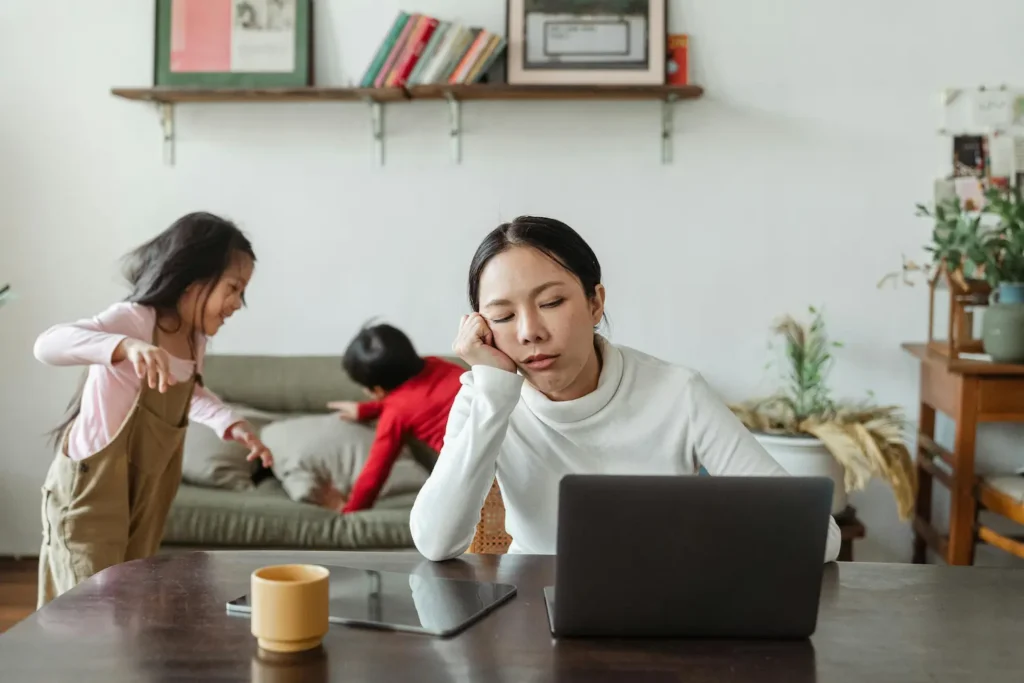
Parenting challenges that stem from exhaustion and difficulties managing everyday life are very common and can cause feelings of helplessness and distress—sometimes profound ones. If we ask ourselves what causes parental exhaustion, we may realize that there are undeniable external factors, but internal factors as well.
The key to therapeutic support for mothers, fathers, and caregivers lies in an attitude of de-shaming: easing the burden of guilt so that we can see more clearly what is really happening.
Guilt and Responsibility: A Crucial Difference
Removing guilt does not mean eliminating all responsibility. There is an important difference between guilt and responsibility. Responsibility means taking ownership of limitations, health issues, personality patterns, or circumstances that prevent you from showing up with your children in the way you would like.
For example: even if you want to practice respectful parenting, you may find yourself yelling at your child because you have lost patience. The key is to ask yourself why, rather than remaining stuck in the thought, “I am a bad mother” or “I am a bad father.”
Why Do I Feel Guilty? The Locus of Control Theory
This theory can help us understand why you blame yourself. Rotter (1966) defined locus of control as the tendency to interpret the extent of one’s own influence over the outcomes of one’s actions.
When it is more external, a person tends to attribute consequences to events or structures beyond their control. When it is more internal, a person tends to attribute certain consequences to themselves.
Because of the gender-related issues mentioned above and social pressure, mothers can easily develop an internal locus of control. This attitude can also contribute to a depressive tendency, especially when someone moves from responsibility into guilt.

Conscious parenting should not come at the expense of your well-being. Caring for your emotional health is an essential part of caring for your children and easing parental exhaustion.
The Invisible Pressure on Mothers
This article is for you, whether you are a mother or a father. I believe that parenting challenges can be extremely demanding for both parents, who often share many of the same difficulties. However, it would not be balanced not to acknowledge that, in most cases, the responsibility for parenting still falls primarily on the maternal figure.
Although fathers are increasingly involved in childcare, social reality shows that mothers are still the ones who more often request career breaks or reduced working hours and who predominantly handle child-related management tasks, such as communicating with schools, dealing with healthcare matters, preparing meals, and managing other household responsibilities.
The fact that caregiving responsibilities fall mainly on mothers creates a tendency toward social pressure on the maternal role. We expect so much from mothers and want them to be perfect and almost infallible, sending extremely harsh messages—often without realizing it—and reinforcing mothers’ anxiety about “doing it right” all the time. Respectful parenting should not mean exhausting parenting.
A Resource for Mothers During Difficult Moments
Here is a small resource created to support mothers through the most challenging stages of parenting, especially when parental exhaustion is combined with guilt and self-imposed pressure. It can be a first step toward treating yourself with more kindness and opening the door to therapeutic support if you need it.
If you would like to learn more about mental health and motherhood, you can also explore the resources from the World Health Organization (WHO) and the Official College of Psychology of Catalonia (COPC), where you will find general guidance on psychological well-being.
Disclaimer: This content is for informational purposes only and does not replace professional consultation. If you feel that parental exhaustion is affecting your well-being or your relationship with your children, you can request a personalized assessment.