
Parenting guidance is not a psychotherapeutic intervention, but rather a guidance-based approach designed to give parents insight into their child’s development and current emotional situation. It can be a preliminary intervention before psychotherapy—for either the parent or the child—but it can also remain a specific intervention in its own right.
It can take the form of ongoing support over time, but it may also involve a brief intervention or even a single session.
Every case is unique and unrepeatable. Therefore, it is not possible to decide in advance exactly how this intervention should unfold. It is not about applying a rigid protocol, but about assessing each situation and choosing the approach that best meets the patients’ needs, always keeping the best interests of the children at the centre.

When should you seek parenting guidance?
Parenting guidance can be sought at any age. Parents of a teenager, for example, may seek support to help them understand where the boundary lies between developmentally typical and concerning behaviours, whether there are warning signs, what to do, and how symptoms could be addressed.
Psychotherapy is not always the answer. Sometimes, indirect support can shed light on a situation and help change family dynamics, even when the work does not take place in a therapeutic setting.
It is true, however, that the vast majority of requests for parenting guidance come from families with children aged between 0 and 6. This is the stage when the family is most influenced by the children’s emotional states, while parents also have more direct tools to support them because children are still extremely dependent on their family environment.

How does parenting guidance work?
From the therapist’s perspective:
One question I am often asked is why I request that the first parenting guidance session be longer—an hour and a half, while subsequent sessions last one hour. The answer is simple: because there is a great deal of information to gather.
If we begin child or adolescent psychotherapy, we know that there will be more opportunities to gather information: we will see the parents regularly while also seeing the child in sessions. However, if we are providing parenting guidance alone, we need all the information to come from the parents’ observations. For this reason, the initial assessment needs to be extremely thorough.
In addition, although this is not always the case, parenting guidance often consists of a single session or a few sessions spaced out over time. We therefore need to provide specific guidance and instructions for collecting information based on how these recommendations are applied at home.

Finally, parents need to leave the first session with something concrete: a recommendation to put into practice, instructions about what to observe and record, or something similar. In my clinical experience working with families and children, I have seen that this is a highly effective intervention, but also a very demanding one for the therapist. It involves researching a wide range of topics between sessions, sending resources such as videos, articles and tracking forms, and reading and interpreting the information that parents bring or send. One hour is not enough for the first contact and does not adequately respond to the family’s needs, whereas a greater initial commitment can lay the foundations for a genuinely effective intervention.
From the parents’ perspective:
Parenting guidance nevertheless requires a fairly high level of commitment from parents. It may seem that not having to take the child to a weekly session is less demanding. However, what is addressed during the session then needs to be applied, especially if the aim is not only to obtain a professional opinion but also to achieve a change in the child or in family relationships. This means having fewer sessions, but being willing to work at home using scientifically grounded recommendations—that is, recommendations aligned with child development psychology and supported by neurophysiological evidence.
As with psychotherapy, problems do not resolve themselves. They require personal effort and commitment—and, in this case, commitment from the whole family.
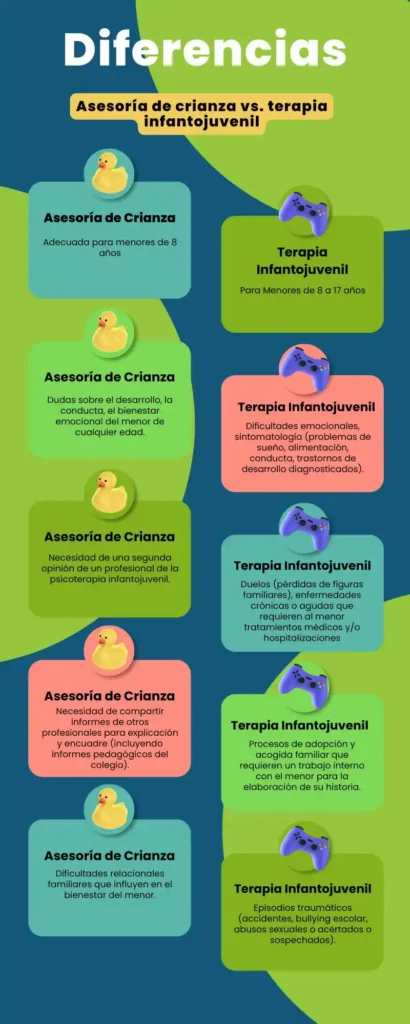
Differences between parenting guidance and child or adolescent therapy
To help clarify which intervention is most appropriate in each case, I suggest looking at the following diagram. Keep in mind that rigidity has no place in therapy, meaning that every case is unique. This is simply a general overview intended to provide clarity, but the situation may be approached differently depending on the individual circumstances.
I invite you to contact me so we can talk about all the benefits that our groups and individual therapies can offer you.
In the meantime, follow me on Instagram and on my YouTube channel, where I share daily content about parenting, yoga and many other therapeutic techniques to support your physical and mental wellbeing.